Market Monday: Levels of the Game
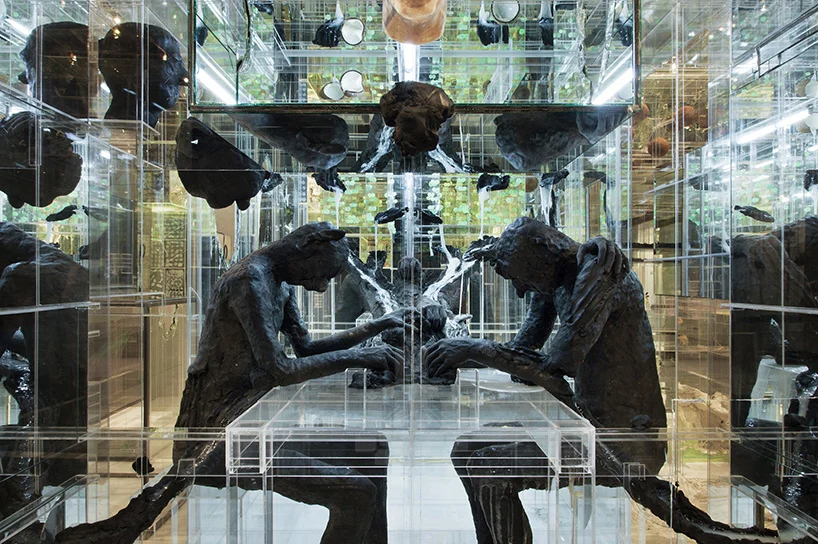
David Altmejd, "The Flux and the Puddle" (detail), 2014. Image credit: designboom.
This week, three reminders that industry players react not just to their roles but to their standing within those roles…
Optimal Market Timing: After 23 years at Christie's, including the last five at the helm of the house's top-earning postwar and contemporary department, Brett Gorvy announced that he will switch sectors to partner with high-end gallerist Dominique Lévy. According to Gorvy, the motivation behind Lévy Gorvy, as the venture will be known, is to continue building on his co-founder's "boutique mentality of what a dealer is"––a mentality he relates to revered predecessors like Daniel-Henry Kahnweiler, Leo Castelli, and Anthony D'Offay. Yet according to Artsy's Abigail Cain, the gallery will also reportedly run a "bespoke advisory and collections management service" and "place priority on growing its business in China"––not exactly moves driven by an old-time infatuation with art for art's sake.
Much of the art-media dialogue around Gorvy's decision so far centers on a theme close to The Gray Market's temperate, analytical heart: the increasing fluidity between formerly distinct sectors of the art industry. Yet Gorvy contends that he exited the auction game partly because, even at its pinnacle, the private-sales realm is significantly less manic and deal-centric in comparison. Now, the two sectors certainly have their differences. But the land-bridge recently formed between them––the very thing that has allowed Gorvy and many others to so easily travel back and forth at will––exists partly because the same pace, pressure, and bottom-line thinking now rule both sides. Remember, six months ago, Lévy was the subject of a Times feature in which she humble-bragged about being such a sales machine in heels that she has to soak her feet in an ice bucket midway through each day of Art Basel––an event she also described by saying, "This is not an exhibition, this is an art fair. It's about commerce."
To be clear, Gorvy has every right to do what he wants professionally, as well as to spin whatever narrative he wants about that choice. But given that he knows Christie's business as well as anyone, I can't help but wonder if at least a small part of the reason he's switching platforms may be that he feels Sotheby's, now in the midst of a streak of forward-looking moves and strong sales results, is (finally) gaining meaningful ground on his former employer. If so, then Lévy Gorvy exists partly because Gorvy is simply doing with his auction career what he did for two-plus decades with other people's pictures: selling high. [Artsy]
The Forever War: After concluding that the video for French rappers Dosseh and Nekfeu's "Putain d’époque" had inexcusably ripped off his 2007 installation "Ghost," ascendant multidisciplinary artist Kader Attia sued Universal Music France for copyright infringement earlier this week. However, after concluding that Attia's lawsuit threatened the rights of sub-superstar talent across all media, fellow multidisciplinary artist Kendell Geers published an open letter savaging Attia for, essentially, valuing his own success over the freedom of his rank-and-file colleagues, all of whom he argues deserve to be able to sample, appropriate, and repurpose other artworks without fear of reprisals from the throne room. Then Attia sniped back at Geers, basically calling his letter nothing more than a case of attention whoring; people in the art world semi-reluctantly started declaring (mostly) for Team Kendell or (occasionally) Team Kader; and meanwhile, somewhere in Paris, Universal Music France's attorneys began slavering over the opportunity to descend on Attia's claim like Mason Verger's man-eating boars in "Hannibal" [NSFW, obviously].
Although I'm sure it's an unpopular take, I'm sympathetic to both sides here. To appropriate a phrase from my friend in the agriculture industry, nothing chaps my ass like a frivolous copyright complaint, and, as Greg Allen points out, Attia's meatiest beef with Dosseh and Nekfeu's video amounts to a one-second drone shot where a group of mylar-wrapped actors kneel in prayer a la the static figures in "Ghost." At the same time, Attia––who is still nowhere near being a household name on the order of a Koons or Hirst––isn't suing Dosseh and Nekfeu, or even the video's director. He's suing Universal Music France, the regional arm of a global conglomerate that generated $5.66 billion in revenue last year. How rare is it to see many, if not most, art enthusiasts align themselves with a multinational corporation at the expense of a respected yet relatively unassuming contemporary artist, even if the issue at hand is more than a little murky?
In the end, the Attia-Geers dustup illustrates the paradox of ambition facing visual artists. First, as Geers asserts, they must fight like mad to try to reach the public consciousness in any capacity. Then, if they succeed even as much as Attia, they must be hyper-vigilant about trying to preserve their ownership of whatever modest parcel of psychic real estate they've managed to claim in the culture. And the more well-known they become, the likelier it becomes that they'll eventually be taken advantage of by some bigger force. Because as soon as their work zooms out from the tiny spinning pebble that is the art world, it becomes vulnerable to being sucked into the gravitational pull of hulking mass-market stars and their backers. (Imagine how it would have gone for Pipilotti Rist if she'd sued Columbia Records, Parkwood Entertainment, and Beyoncé over "Lemonade.") So while I agree with Geers's evocation of Lautréamont––namely, that "plagiarism is necessary" for the progress of art––I can also understand why Attia and other plagiarized artists might get overprotective of their work and legacies. Appropriation without compensation doesn't always feel like a compliment when it's being greenlit by faceless billionaires. [The Art Newspaper]
Big Data or Big Problem?: Finally this week, Sarah P. Hanson reviewed two recent deals between major for-profit players and boutique art-market analytics firms, with an eye toward how big data could change the industry sooner than most think. Through Sotheby's acquisition of the Mei Moses indices and Artnet's acquisition of Tutela Capital SA, she explores data science's prospects for enhancing the efficiency of the sales process and possibly even securitizing artwork as an indexable investment asset. If that dual outcome were to arrive one day, it might be enough to compel power brokers in Chelsea, Silicon Valley, and Wall Street to start frantically humping each other like they'd just tossed their keys into a bowl at a swingers' party.
But while I agree wholeheartedly that technology can––and in fact, must––help the art trade advance beyond the age of napkin invoices and notebook-paper releases, I'm dubious of just how useful analytics will be in that effort. Full disclosure: I increasingly believe that big data may be the most overvalued concept in 21st century life, with Exhibit A being the world-shaking discrepancy between reality and almost all next-generation polling models' predictions about the 2016 US election. But even if you're bullish on big-data, I think the problem with its application to the art market begins with the word "big."
As we just discussed via Attia vs. Universal Music France, the art industry is a niche industry––a space where the Mei Moses index tracks only about 45,000 artworks auctioned multiple times, and in which, if you believe the TEFAF Art Market report, the median number of sales made by each private fine-art and antiques dealer in 2015 was just 70, via only 40 individual buyers per business. Even if we had access to every scrap of data in the private market––which, as one of Hanson's sources helpfully reminds readers, we don't––how much high-level information could we really glean from such a small sample size? Does Sotheby's, for example, really need serious machine learning to assemble a list of similar artworks to offer a lot's underbidder 24 hours after a sale, as Tad Smith wants? And even if it does, how much will that innovation really change the market?
Suffice it to say that I think tech's greatest value to the industry lies elsewhere. But at the moment, art businesses at the top of multiple sectors are mythologizing big data as the next killer app. The question, though, is whether their mythology can stand on the ground they actually occupy––or whether, instead, their position as sector leaders is just allowing them to unwittingly 538 themselves. [The Art Newspaper]
That’s all for this edition. Til next time, keep striving for higher ground.